
Hospitality Trends 2026: A New Era of Tourism Driven by Technology and Authentic Experiences
18 September, 2026
St.Pol HC Hosts an MCEU Hospitality Roundtable on Micro-Credentials and Their Impact on the Labour Market
16 October, 2026
Spain welcomed nearly 96.8 million international tourists in 2025, ranking as the world’s second-largest tourism destination. Catalonia was the Spanish region that received the most international visitors, while the United Kingdom, France and Germany were the leading source markets.
Every year on 27 September, World Tourism Day invites us to reflect on the importance of an industry that connects cultures, drives economic growth and creates career opportunities around the world. In Spain, the figures highlight the scale of this sector and its relevance to the future of hospitality, gastronomy and destination management.
To mark this occasion, we look at some of the key indicators of tourism in Spain, based on official data from the National Statistics Institute (INE).
96.8 million international tourists in 2025
Spain ended 2025 with 96,770,515 international tourists, a 3.2% increase compared with 2024 and a new all-time high, according to the INE’s Tourist Movements at Borders Survey (FRONTUR).
This figure reinforces Spain’s position as one of the world’s leading tourism destinations. In 2025, the country ranked as the world’s second-largest tourism destination, strengthening its appeal to travellers from around the globe. The growth in arrivals also presents challenges for the sector: improving service quality, managing tourist flows, moving towards more sustainable models and delivering experiences that create value for both visitors and local communities.
How is tourism evolving in 2026?
Tourism figures remain positive this year, continuing the sector’s upward trend so far. The latest provisional INE data available for this article cover July 2026. During the first seven months of the year, Spain welcomed more than 58.1 million international tourists, a 4.6% increase compared with the same period in 2025. In July alone, 11.5 million international tourists arrived in Spain, also 4.6% more than in July of the previous year.
These figures point to continued growth in international arrivals during the first seven months of 2026. However, the final annual results are not yet available, and we will have to wait until the end of the year to make a meaningful comparison between 2026 and the previous year.
Where do tourists visiting Spain come from?
The United Kingdom, France and Germany remain among the main source markets for international tourists visiting Spain. FRONTUR data for 2025 reflect the diversity of origins of travellers who choose the country as their destination.
The leading source markets include:
United Kingdom: 19.1 million tourists.
France: 12.8 million.
Germany: 12.0 million.
Italy: 5.7 million.
The Netherlands: 5.0 million.
United States: 4.5 million.
Portugal: 3.4 million.
Belgium: 3.1 million.
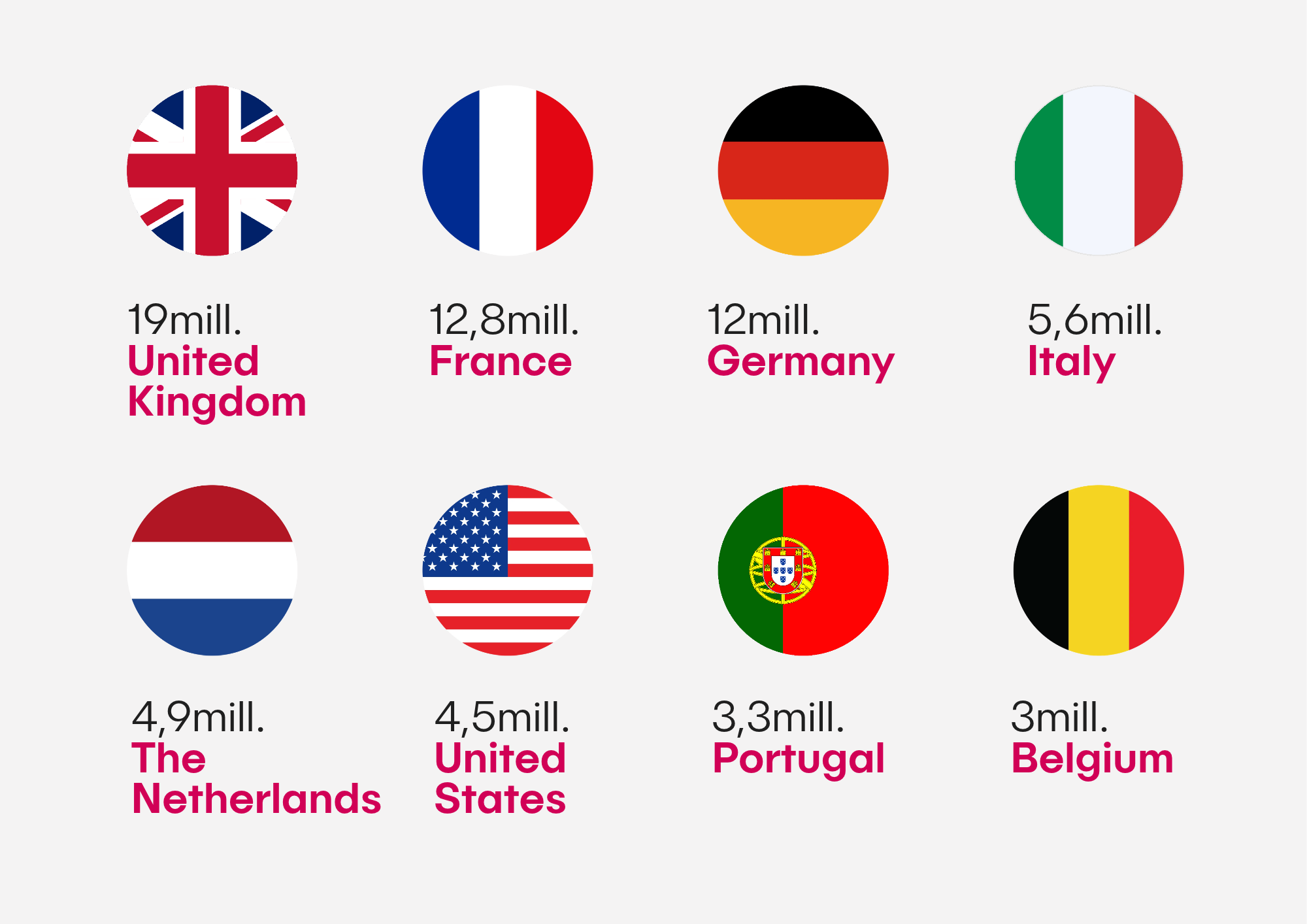
The diversity of these markets highlights the importance of understanding different traveller profiles, languages, consumer habits and service expectations. For hospitality and restaurant professionals, understanding these differences is essential to designing experiences tailored to an international clientele.
Catalonia, Spain’s leading destination for international tourists
Among Spain’s autonomous communities, Catalonia topped the rankings in 2025, welcoming approximately 20.1 million international tourists.
According to INE data, the Spanish regions that received the highest number of international visitors were:
Catalonia: 20.1 million.
Balearic Islands: 15.7 million.
Canary Islands: 15.7 million.
Andalusia: 14.5 million.
Valencian Community: 12.4 million.
Community of Madrid: 9.1 million.
These figures refer to the autonomous community declared by international tourists as their main destination.
Catalonia’s position reflects the appeal of a region with a diverse offering that combines urban destinations, coastline, cultural heritage, nature and gastronomy. Barcelona and the rest of the region are part of a tourism ecosystem in which accommodation quality, food services and visitor experiences play an important role.
At the same time, the distribution of arrivals across Spain’s autonomous communities highlights the variety of experiences available throughout the country and the importance of adapting tourism management to the characteristics of each destination.
Beyond the numbers: the value of talent in tourism and gastronomy
Spain’s leading position in the tourism sector is not due solely to its high number of visitors. Quality of experience, professional development, innovation, sustainability and management capabilities are essential factors in maintaining the competitiveness of destinations and businesses.
In this context, specialised education is key to the sector’s growth and excellence. The hotel, gastronomy and restaurant industries need professionals equipped to lead teams, manage businesses, understand market trends and respond to the needs of an increasingly diverse clientele.
At St.Pol HC, training in hotel management, restaurant management and culinary arts connects these fields with the real challenges facing the industry. Because behind every stay, every service and every gastronomic experience, there are people, knowledge and talent.
World Tourism Day: looking towards the future of the sector
The figures for 2025 and the growth recorded during the first seven months of 2026 highlight the strength of international tourism in Spain. The challenge now is to turn this appeal into balanced, competitive and sustainable development.
Celebrating World Tourism Day also means recognising the role of those who make every experience possible and the importance of continuing to train the professionals who will lead the sector in the years to come.
Sources: National Statistics Institute (INE), Tourist Movements at Borders Survey (FRONTUR), 2025 results and July 2026 data.







 CALL US
 WHATSAPP